


BRAND STRATEGY
Know where you're going and why you can win there
Brand strategy should give the business clarity on where it is going, where it can compete and what the brand needs to do to help get it there.
As a Dubai-based agency, we help founders and leadership teams build brand strategy that’s grounded in the realities of the business, the market, the customer and the competition.
From launching and repositioning to premiumisation, expansion and transformation, we build brand strategies designed for where the business wants to go next.
Talk to us about your brand.
Our Point-of-View
This isn't the part where we come up with three words and call it a strategy.
Purpose. Values. Personality. Archetypes. Brand pillars. Positioning statements. They can all have a place in brand strategy.
But completing the framework isn’t the same as finding the answer.
Strategy has to do something more consequential. It has to make sense of what we know about the business, the market, the customer and the competition, then turn that understanding into choices about where the brand should go and how it should compete.
Otherwise, strategy risks becoming an elaborate explanation for a creative answer someone was already hoping to make.
We don’t use strategy to justify the creative.
We use strategy to determine the direction.
Then the creative has something worth expressing.
Brand Strategy is Business Strategy
Businesses don’t usually arrive at the need for brand strategy because everything else is standing still. Something is changing. The company may be entering a new market, moving into a more premium space, preparing to scale, facing stronger competition, launching something new, or discovering that the brand that got the business here may not be the one that takes it where it wants to go next.
And sometimes leadership knows that something needs to change without yet knowing exactly what the answer should be. That’s where the real strategic work begins.
Because the question that arrives as a brand question may have something bigger sitting underneath it. Before deciding how a business should position itself, we may need to understand which opportunity is actually worth pursuing. Before defining a new proposition, whether the business can credibly deliver it. Before changing the brand, what still carries value and should be protected.
We go far enough into the business to understand what the brand actually needs to solve. Not to write the business strategy for you, but because a brand strategy cannot be credible if it ignores the business reality it has to serve.
And in doing that work, we sometimes help leadership clarify decisions about the business that need to be resolved before the brand can move forward.
Good strategic direction starts with understanding the whole picture.
A brand doesn’t operate in isolation. Where it should go next, and the position it can credibly occupy, depends on the business, what it offers, who it serves and the market in which it competes. Research gives us the evidence. The job of strategy is deciding what to do with it.
001
The Business
Ambition, commercial priorities, capabilities, growth plans and the realities of what the organisation can deliver.
002
The Market & Category
How the market is changing, how the category is structured, where conventions have formed and where credible opportunities may exist.
003
The Customer
Who matters most, what they value, how they choose, what shapes their perceptions and how their expectations are changing.
004
The Competition
Who the brand is really competing against, where competitors are clustering, what they are claiming and where meaningful white space may exist.
.
005
The Offer
Products and services, portfolio, value proposition, strengths and weaknesses, and whether the offer supports the position the brand wants to occupy.
006
The Existing Brand
Current positioning, equity, reputation, architecture, expression and experience, including what still has value and what may be holding the business back.
Research isn't the strategy.
The choices are.
You can understand the market, map the competition, study the customer and interrogate the business, and still not have a strategy. Strategy begins when that understanding leads to choices.
Where should the brand compete? Who does it most need to matter to? What can it credibly own? What should distinguish it? What existing equity should it protect, and what needs to change? What should it stop trying to be? And what must the business be able to deliver for the position to be believable?
A good strategy doesn’t try to keep every possibility open. It gives the business something to commit to.
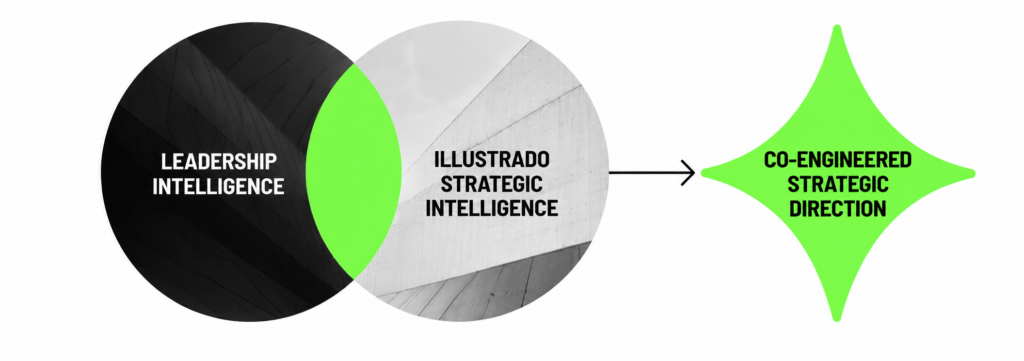
Co-Engineered with Leadership
THE BEST BRAND STRATEGIES AREN’T HANDED TO LEADERSHIP. THEY’RE BUILT WITH THEM.
No outside strategist can know a business the way the people who have built and led it do. Leadership brings ambition, commercial realities, institutional knowledge, operational constraints and an understanding of where the business wants to go.
As a brand consultancy in Dubai, what we bring is different: an independent perspective, market and category intelligence, research, pattern recognition, strategic brand expertise and the willingness to challenge assumptions that may have become accepted inside the business.
We bring those perspectives together to interrogate opportunities, test assumptions and make the choices that will shape the brand. This isn’t collaboration for the sake of consensus or leadership participation for the sake of buy-in. The strategy is better because the people who know the business best and the people brought in to see it differently have engineered it together.
And because leadership has helped build the reasoning behind the strategy, they are better equipped to lead it after we leave the room.

A Dubai Base,
A Wider Field of View
Dubai is our home market, but it is anything but an insular one. Local businesses, regional leaders and some of the world’s most established brands compete side by side, serving customers from an extraordinary range of cultures and backgrounds.
That creates a particular kind of strategic discipline. Businesses aren’t judged only against the company next door or the traditional leaders of their category. Ideas aren’t developed for one culturally uniform audience. Working here means constantly considering how a brand, message or experience will travel across different cultural contexts without losing its meaning.
It is also a market with an unusually strong appetite for what comes next. Ambitious ideas, rapid development and continual reinvention are part of the environment in which businesses here operate. That encourages a mindset we understand well: respect what is real today, while being prepared to imagine what could be possible tomorrow.
For us, that makes Dubai a valuable vantage point for brand strategy consulting. More than two decades of experience in the GCC has given us regional depth, while working across industries, cultures and international markets keeps our frame of reference wider. We can help a UAE business compete more effectively at home, a regional company prepare for its next market, or an international brand understand what it will take to enter and matter in the GCC.
Because the strategy has to know where the business is going, not just where it is now.
What can brand strategy change?
The value of strategy becomes clearest when the business has somewhere important to go, or when the way it has competed until now is no longer enough.
001
Build Credibility
from the Start
Create a credible strategic foundation for how the business should position and present itself, giving customers, partners and the market stronger reasons to take the brand seriously.
002
Bring the Brand Up
to the Level of the Business
When the business has grown stronger but its image, positioning or digital presence hasn’t kept pace, redefine the brand so what people perceive better reflects what the company has become and where it wants to go.
003
Reposition Without Throwing Everything Away
Determine what still carries equity, what is holding the brand back and what needs to change for the business to move forward.
004
Make Premiumisation Credible
Define what greater value should mean for the brand and what needs to change across the proposition, positioning and experience so premiumisation is more than a change in appearance or price.
005
Break Category Sameness
When a brand looks, sounds or behaves generically, differentiation becomes harder and price becomes easier to compare. We map where competitors are clustering, identify credible white space and build a position that gives customers a meaningful reason to choose you.
006
Enter New Markets with Greater Clarity
Determine what should remain consistent, what needs to adapt and how the brand can stay recognisable while becoming relevant to a new market.
007
Prepare the Brand
to Scale
Create the strategic clarity needed for the brand to travel across teams, locations, business units, franchises or markets without becoming fragmented.
Strategy should not end up as a deck
The real test of brand strategy is what happens after the decisions have been made. It should give the people responsible for the brand a clear basis for deciding what comes next, from how the brand is named and expressed to how it communicates, behaves and grows. That direction carries across the wider brand system:
Good strategy makes the next decisions clearer
The exact outputs depend on the challenge we’re solving. But the work should leave leadership with a clearer understanding of the brand’s current reality, a defined direction for where it should go, and a practical basis for the decisions that follow.
A Clearer View of Where You Stand
Depending on the engagement, this can include market and category perspective, competitive mapping, customer and audience understanding, existing brand diagnosis and the key opportunities or challenges the strategy needs to address.
A Defined Strategic Direction
The choices that establish where and how the brand should compete. This may include positioning, differentiation, value proposition, audience priorities, brand architecture, mission, vision and values, or other strategic foundations relevant to the challenge.
Clarity on What Happens Next
Strategic priorities and recommendations that help leadership understand what should be preserved, what needs to change and how the direction should carry into the wider brand, from identity, messaging and experience to internal alignment and marketing.
The output isn’t the number of frameworks we can put into the presentation. It’s the clarity they create for the decisions that come after it.
How we develop strategy
We have an established approach to brand strategy, but the depth and focus of the work depends on the challenge we’re solving. We investigate what is relevant, go deeper where the evidence tells us we need to, and involve leadership throughout the development of the strategic direction.
→ UNDERSTAND
We begin with the business and the people leading it, establishing the ambition, context, challenges and decisions that have brought the brand to this point.
→ INVESTIGATE
We build the evidence around the challenge, drawing from the market, category, competition, customers, offer and existing brand wherever relevant.
→ INTERROGATE
We look for patterns, tensions, assumptions and opportunities. We challenge what appears obvious, test possible directions and determine which opportunities can stand up to scrutiny.
→ ENGINEER
We work with leadership to develop and refine the strategic direction, turning evidence and insight into choices the business can understand, believe in and act upon.
→ MOVE FORWARD
We translate the strategy into clear priorities for the brand, establishing what should be preserved, what needs to change and where the work needs to go next.
Why Illustrado for brand strategy?
Choosing a brand strategy agency in Dubai calls for more than knowing how brands are built. It requires an understanding of the businesses behind them, the markets they compete in and what it will take to turn strategic direction into something the organisation can actually carry forward.
Business-First
We look beyond the brand brief to understand the business realities behind it, so the strategy addresses what actually needs to be solved.
Senior Thinking Close to the Work
Our senior leadership remains directly involved in strategic engagements, bringing decades of experience across brand-building, marketing, creative leadership and entrepreneurship.
Holistic Brand Development
Our approach considers the whole brand and the business behind it, connecting strategy to the offer, experience, expression, people and systems that ultimately have to carry it. It means we don’t develop positioning in isolation from the wider realities that can make it credible, or undermine it.
Cross-Industry Perspective
Experience across sectors gives us a wider reference set, helping us recognise patterns, question category conventions and look beyond what immediate competitors are doing.
GCC Depth, International Exposure
More than two decades of experience in the GCC, combined with international brand experience, gives us both regional understanding and a wider frame of reference.
Explore our Research and Insights
This section should feature links to select pages (white paper, press feature, etc.)
You don't need to have the asnwer before you talk to us.
You may know exactly what needs to change. Or you may simply know that the business has reached a point where its current brand, position or direction is no longer enough. Bring us what you know about the business, where you want to take it and the questions you haven't resolved yet. We'll work through the rest together
Frequently asked questions
What is brand strategy and what should it actually help a business decide?
Brand strategy defines where a brand should go, how it should compete and the choices required to get there. It brings together an understanding of the business, market, customers, competition, offer and existing brand to establish a clear strategic direction.
Depending on the challenge, that can mean making choices about positioning, differentiation, audiences, proposition, architecture and other strategic foundations. Ultimately, the strategy should give leadership greater clarity about what the brand needs to become and what the business needs to do to make that position credible.
When does a business need a new brand strategy?
Brand strategy becomes particularly important when something significant is changing: launching a new business or offer, repositioning, premiumising, entering a new market, preparing to scale or franchise, facing stronger competition, or when the existing brand no longer reflects the strength or ambition of the business.
It can also be valuable when leadership knows something needs to change but has not yet resolved exactly what that change should be.
Can we rebrand without developing a brand strategy?
A rebrand shouldn't begin with deciding what the brand should look like next. It should begin with understanding why the brand needs to change at all.
The business may have evolved. The market or competition may have moved. Customer expectations may have changed. The company may be entering a new market, premiumising, scaling or pursuing a different kind of customer. Or the existing brand may simply no longer reflect what the business has become.
Without examining those realities, a rebrand risks becoming a change of skin without understanding the body underneath it.
That doesn't mean every rebrand requires the same depth of strategic work. If much of the existing strategy remains sound, we may validate and build upon it rather than reinvent it. But there should be a strategic basis for deciding what stays, what changes and why.
Can brand strategy help if our business has outgrown our brand?
Yes. This often happens when a business has grown, improved or become more sophisticated, but the way it is perceived has not kept pace.
Brand strategy can help determine where the disconnect lies and what needs to change so the brand better reflects the capability, value and ambition of the business. That may involve repositioning, redefining the proposition or audiences, or changing aspects of the brand's identity, messaging and experience.
The objective isn't simply to make the brand look more current. It is to bring the brand up to the level of the business and where it intends to go next.
Can you develop a market-entry brand strategy for Dubai, the UAE or the GCC?
Yes. We develop brand strategy in Dubai, the UAE and wider GCC for international businesses entering the region, as well as regional businesses expanding into new markets
A strong market entry brand strategy needs to consider more than translation or localisation. We look at the competitive environment, category dynamics, customer expectations, cultural context and existing brand equity to determine what should remain consistent, what may need to adapt and how the brand can become relevant in the new market without losing what makes it distinctive.
Can brand strategy help us premiumise or move into the luxury market?
Yes. Premiumisation requires more than raising prices or giving the brand a more elevated visual identity. The positioning, proposition, product or service, experience, communication and perceived value need to support the position the business wants to occupy.
For businesses moving into a more premium or luxury space, we examine the market and competitive landscape, the expectations of the intended audience and what the business can credibly deliver. The objective is to build a position that earns its premium perception rather than simply claims it.
Can brand strategy help us differentiate in a crowded or generic category?
Yes, but differentiation shouldn't be pursued simply for the sake of being different.
We examine how the category behaves, where competitors are clustering, what customers value and where credible opportunities may exist. The objective is to find a position the brand can meaningfully occupy and the business can genuinely support, giving customers a stronger reason to choose it rather than relying primarily on familiarity, promotion or price.
Can brand strategy help prepare our business for scaling or franchising?
Yes. As a business expands across locations, teams, franchises or markets, inconsistencies that were manageable at a smaller scale can quickly become bigger brand problems.
Brand strategy establishes greater clarity around what must remain consistent, what can adapt and what the organisation needs to protect as it grows. It can also identify where clearer brand architecture, experience principles, messaging, internal systems or guidelines may be needed so the brand can scale without becoming fragmented.
Who from our leadership team needs to get involved in the brand strategy process?
We typically need meaningful involvement from the people responsible for the direction of the business, particularly founders, owners or senior leadership, alongside relevant marketing or brand leaders.
Their involvement is not simply for approval. Leadership holds knowledge about the business, its ambition, commercial realities and future plans that is essential to developing a credible strategy. We bring the external perspective, research, strategic brand expertise and challenge needed to co-engineer the direction with them.