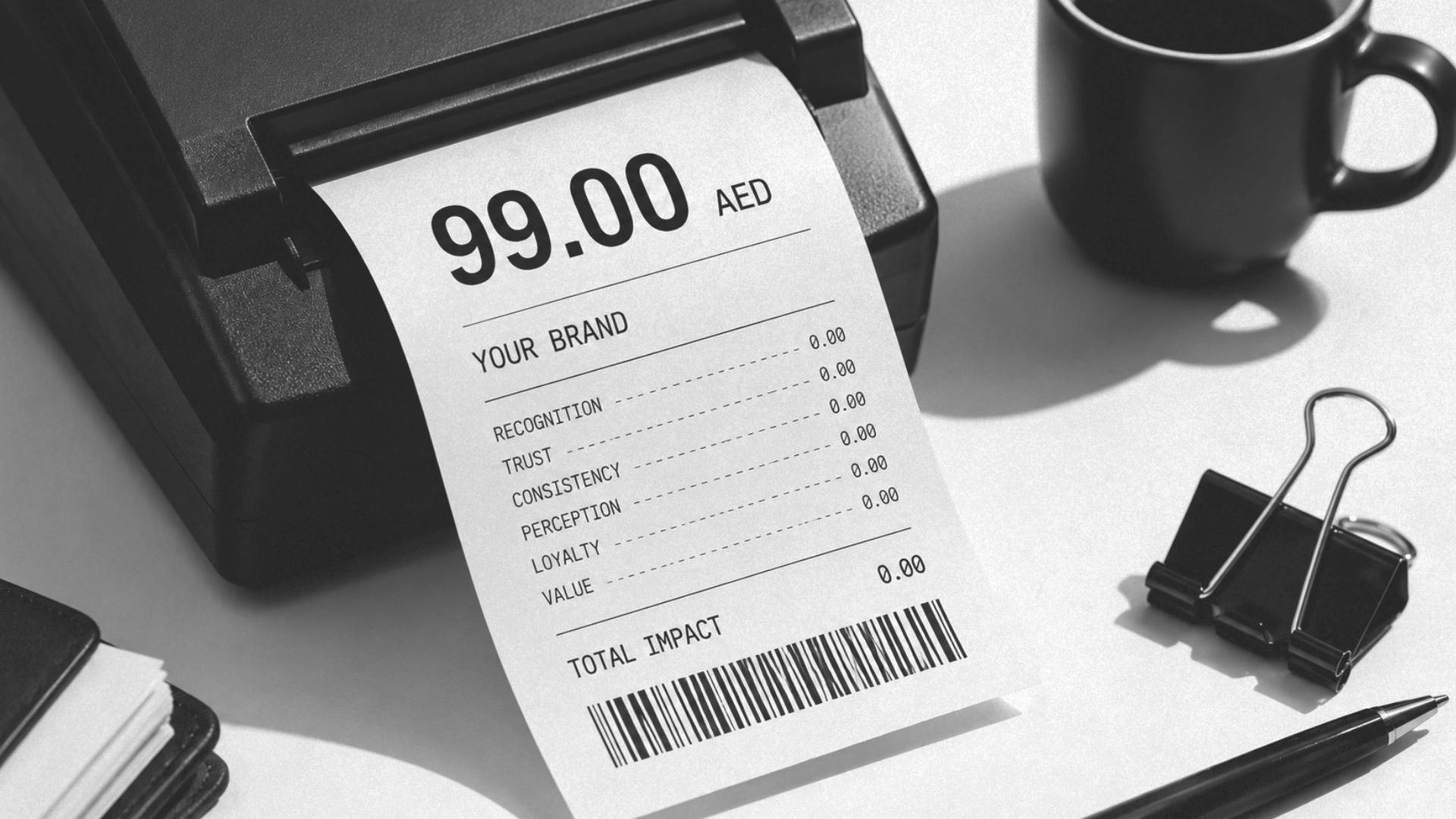
Walk into any mall in Dubai on a Thursday evening and you will see the same pattern repeating itself across categories that have nothing else in common. A fashion retailer that spent years building a premium retail environment is running a flash sale graphic with red starburst clip art. A heritage homeware brand is posting a trending audio clip with a discount code stamped over it. A watch brand with a genuinely elevated product is speaking to its audience in the same tone as the electronics store two units down.
None of these brands set out to look like a discount outlet. Each decision, taken on its own, made sense to whoever approved it. Footfall was soft that week. Inventory needed to move before the season changed. A regional trend was getting engagement and someone on the team wanted a piece of it. Every choice was reasonable. The sum of those choices is a brand that no longer sounds like the brand it was built to be.
This is not a design problem or a copywriting problem. It is what happens when marketing quietly stops being the function that builds a brand and becomes the function that moves inventory instead.
The mandate got smaller, not marketing itself
Most marketing teams we work with are not short on talent or ambition. What has shrunk is the brief they are actually given, week to week. Ask marketing leads across UAE retail what their calendar looks like and the answer is remarkably consistent: clear this stock, support that promotion, drive footfall this weekend, push the seasonal collection before it competes with the next one coming in.
Every one of those asks is legitimate. Retail businesses have to sell what is on the floor and in the warehouse. The problem is not that these objectives exist. The problem is when they become the only objectives marketing is ever asked to deliver against, quarter after quarter, until nobody on the team remembers the last brief that had nothing to do with moving product that week.
Marketing built for stock movement looks different from marketing built for brand building, even when the same people are producing it. It answers to different questions. Did the promotion clear inventory. Did footfall improve this weekend. Did the post get engagement. None of those questions ask what a customer now believes about the brand after seeing it, or whether they would still choose it if the offer disappeared tomorrow.
What customers are left remembering
Ask a customer to describe a brand they have followed for two years and, increasingly, what comes back isn’t a point of view or a distinct identity. It’s a sequence of moments: another sale, another drop, another “limited time” banner, another collection nobody asked for arriving before the last one sold through.
None of these moments are inherently damaging. Repeated often enough, without anything else in between to counterbalance them, they become the entire relationship. The promotion stops being something the brand does occasionally and becomes the only thing the brand is known for doing. At that point the brand has not disappeared. It has simply been replaced, in the customer’s mind, by its own clearance events.
The four Ps are eating the fifth
Classic retail marketing runs on product, promotion, price and placement, and there is nothing wrong with any of them. They are the mechanics that get a product in front of a buyer and get it sold. What tends to disappear is everything that determines whether a customer prefers this brand over the next one on the shelf: meaning, memory, distinctiveness, the reasons someone would pay more or wait longer for this option specifically.
The commercial engine keeps running through all of this. Sales targets get hit, or come close enough. That’s precisely why the erosion is hard to catch in the moment. Nothing on the P&L flags that the brand is quietly losing the thing that made it worth building in the first place. The engine that generates preference stalls silently, while the engine that generates transactions keeps everyone convinced nothing is wrong.
Naming the gap: brand dissonance
There’s a specific, recognizable pattern worth naming, because once you see it you notice it everywhere. Call it brand dissonance: the gap between the perception a brand is trying to build and the behaviour it repeatedly demonstrates through its own marketing.
It shows up in familiar combinations. Premium positioning delivered in discount-store language. A heritage brand chasing every trending format regardless of fit. Luxury pricing paired with constant urgency messaging, as if the product might not be worth the wait. Considered quality messaging drowned out by a promotional calendar that never has a quiet week.
Every piece of communication a brand puts out either reinforces the perception it’s trying to build, or quietly works against it. There’s no neutral middle ground. A caption that sounds like a clearance banner doesn’t cancel out against the elevated campaign from three weeks earlier. It sits alongside it in the customer’s memory, and over time the louder, more frequent signal wins.
When brands borrow the wrong voice
The clearest version of brand dissonance shows up in tone. A brand invests real money in better products, premium materials, a refreshed store environment, an elevated visual identity. Then it posts content that reads “99 DIRHAMS ONLY,” in the same capital letters and the same exclamation marks that every discount retailer in the same mall is using. Or it adopts a trending video format wholesale, with the same transitions and the same urgency, because the format is getting reach elsewhere.
Customers do not experience the campaign and the brand as separate things. They absorb both at once, as a single impression. A brand that consistently sounds like a discount store, regardless of what its price tag says, eventually gets valued like one. Perception follows behaviour, not intention.
Premium is a behaviour, not a price point
It’s worth being precise here, because this argument gets misread as an argument against affordability. It isn’t. Premium is not defined by the number on the price tag. It’s defined by how a brand behaves: how it speaks, how urgently it asks a customer to act, what it chooses to celebrate, the confidence or the anxiety it projects in its own communication.
An accessibly priced brand can speak with restraint, clarity and authority, and be experienced as considered and confident. An expensive brand can undercut its own pricing by sounding transactional and desperate every time it opens its mouth. The price tag sets an expectation. The tone of voice either honours that expectation or quietly contradicts it, post by post.
Trend-chasing isn't a strategy
None of this is an argument against participating in culture. Brands should show up where their audience already is, in formats that audience already enjoys. The failure mode isn’t participation. It’s losing your own voice in the process.
A brand that adopts every trending audio, every viral format, every social gimmick the moment it appears becomes harder to tell apart from every other brand doing the same thing at the same time. Reach goes up. Recognition goes down. A brand that is instantly recognisable without its logo has something a brand chasing this week’s format will never build: a voice nobody else can borrow.
The counterpoint that matters
This isn’t an argument against promotions. Retail businesses need promotions, and pretending otherwise would be dishonest about how the category actually works. The argument is narrower and more specific: promotions should reinforce what a brand stands for, not replace it as the only thing the brand ever says.
Marketing in retail has two jobs that have to run at the same time, not in sequence. Sell today’s inventory. Build tomorrow’s demand. Neither job excuses neglecting the other. A calendar that is one hundred percent promotional cannot build demand for anything beyond the next markdown. A calendar with no commercial pressure at all won’t survive contact with a retail P&L. The brands that hold their position over years are the ones that never let one job fully displace the other.
The question worth asking before the next brief
Marketing’s job was never simply to announce what’s available this week. It’s to shape what the brand comes to mean over time, one post and one campaign at a time, whether anyone planned it that way or not. Every piece of communication trains a customer on how to value what they’re looking at.
Before the next promotional brief goes out, it’s worth asking a plainer version of the question this whole pattern comes down to: are we building preference, or are we just clearing stock? Both are legitimate jobs. Only one of them is still standing after the sale ends.